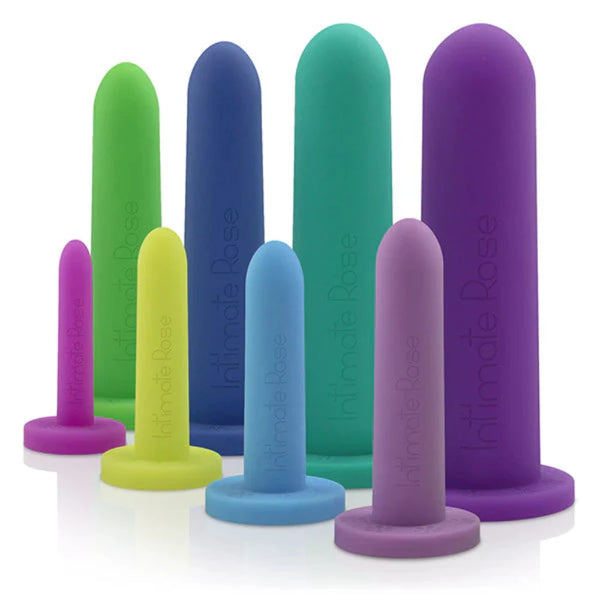
If you've just been handed a box of vaginal dilators, by your physio, your specialist, or your own late-night research, and you're sitting there wondering what now?, you're in the right place. Dilators are one of the most common, gentlest tools we recommend in pelvic health. Used slowly and with a bit of patience, they shouldn't hurt. This guide covers what a dilator actually does, which size to start with, how much lubricant to use, how long to stay with it, and how often. It's written for anyone starting out, whether that's for vaginismus, menopause-related changes, recovery after gynae surgery or cancer treatment, or ongoing pelvic pain. I'm Jade, founder of Blossom Pelvic Health and an APA titled Sports & Exercise Physiotherapist with a special interest in pelvic health, and this is the version I'd talk you through in clinic.
What is a vaginal dilator (and what does it actually do)?
A vaginal dilator is a smooth, tube-shaped device, a bit like a slim, firm wand, that you insert gently to help the vaginal tissues and pelvic floor muscles get more comfortable with the feeling of insertion, at your own pace. They almost always come as a graduated set: a run of sizes from very slim up to larger, so you start small and step up only when you're ready.
It helps to be clear about what a dilator is and isn't. It isn't a quick fix, and it isn't something you do in isolation. It works best as part of a pelvic-physio-led plan, alongside breathing, relaxation, and sometimes hands-on physio. What it gives your body is gradual, repeated, low-pressure practice, and for a lot of people that's exactly what shifts things.
Still deciding which set is right for you? Our comparison of vaginal dilator sets breaks down sizes, materials and features side by side. And if you've been weighing a dilator against a wand, how a pelvic wand and a dilator differ is worth a read, because they do genuinely different jobs.
Who uses vaginal dilators?
People come to dilators from very different places, and almost everyone arrives feeling like they might be the only one. They're not. Here are the most common reasons people start.
Vaginismus and painful sex
When the pelvic floor muscles tighten involuntarily, insertion can feel impossible or painful, whether that's a tampon, a cervical screening test, or sex. Dilators give those muscles a calm, predictable way to get used to the sensation again, gradually. If this is you, our guides on managing vaginismus at home and what causes deep pain during sex go further.
Menopause and vaginal changes (GSM)
With lower oestrogen around perimenopause and menopause, vaginal tissue can become thinner, drier and less stretchy. This is part of what's called genitourinary syndrome of menopause, or GSM. Many women use dilators, with plenty of lubricant, to keep tissues comfortable with gentle stretch. There's more on the bigger picture in menopause and your pelvic floor.
After gynae surgery, cancer treatment or radiation
Pelvic radiation and some gynaecological surgeries can leave the vaginal walls tighter or more sensitive. Dilators are a standard part of recovery here, usually started on a schedule your treating team sets. A good deal of the published clinical guidance on dilators comes from exactly this setting, and you'll find some of it linked at the end.
Pelvic pain and an overactive pelvic floor
A pelvic floor that's working too hard, what we call hypertonic, can sit behind ongoing pelvic pain, and gentle dilator work can be one piece of helping it settle. Our article on pelvic pain in women covers the wider picture.
One thing to hold onto across all of these: a dilator is something people use as part of a plan for these experiences, not a product that 'treats' any of them. The work is yours, gentle and gradual, ideally with a clinician alongside.
Before you start: what you'll need
A short kit list makes the whole thing easier:
- Your dilator set - with the smallest size ready to go.
- A good water-based lubricant - water-based matters here, because silicone lube can degrade silicone dilators over time. We get into the why in what lubricant to use with dilators, and Sliquid H2O is a simple water-based option.
- Privacy and unhurried time - even ten minutes where you won't be interrupted.
- A towel to lie on - and somewhere comfortable.
- Optional, a dilator handle - if reaching comfortably is awkward, it gives you more control without straining.
How to use a vaginal dilator, step by step
This is the core of it. Go slowly. There's no prize for rushing, and slower genuinely works better.
- Set up - pick a calm, private time, empty your bladder, and wash your hands and the dilator.
- Get comfortable - sit propped up against a few pillows so you're semi-reclined rather than flat, knees bent. Or try a supported butterfly: soles of the feet together, knees dropping out to the sides, a pillow under each knee so nothing has to hold itself up. Real life counts too. If the only privacy you get is in the bathroom, one foot up on the edge of the bath or toilet works perfectly well. The aim is simply for your hips and pelvic floor to switch off.
- Breathe first - a few rounds of slow diaphragmatic breathing, belly rising on the in-breath, before you insert anything. This settles the pelvic floor so it's softer to work with.
- Lubricate generously - apply plenty of water-based lube to the tip of the smallest dilator and around the vaginal opening. More is better. Too little is one of the most common reasons it feels harder than it should.
- Rest the tip first - bring the smallest dilator to the vaginal opening and let it rest there for a moment, no pushing, so you get used to the feeling before anything goes further.
- Ease it in, angled back - as you breathe out, let the dilator slide in with gentle pressure, angled slightly towards your lower back, the same line you'd use for a tampon. Think of it less as pushing it in and more as your body letting it in. A soft bear-down, as if you're gently letting go to pass wind, often makes that easier. Never force it.
- Stop at resistance, not pain - when you feel the muscle resist, pause there. Don't push through, and don't yank it straight back out either, since that can make everything tense up. Stay still, breathe, and give the muscle time to soften around the dilator. Resistance is the signal to wait, not to force.
- Hold and settle - once it's comfortably in, leave it in place for around 10 to 15 minutes (some plans go up to 20). You don't need the full time at first. Even a few minutes counts when you're starting. If your physio has you adding gentle movement, easing the dilator part-way out and back in, or slow circles, keep it unhurried and within comfort.
- Remove and clean - when you're done, a gentle bear-down again helps ease the dilator out. Wash it (more on that below) and store it clean.
The two principles that matter most, the ones I repeat in clinic, are these: stay at resistance, never pain, and go at your own pace. Everything else is detail.
How often and how long should you use a dilator?
As a general rhythm, most plans land around a few sessions a week, roughly 10 to 15 minutes each. But the honest answer is that the right routine is the one your pelvic physio or clinician sets for you. It depends on why you're using a dilator and how your body responds.
What's consistent across the board is that consistency beats intensity. Short, regular, calm sessions do more than occasional long ones. The research on dilator therapy points the same way, with the people who stick to a manageable routine tending to do best. Sticking with it is genuinely the hard part, and the evidence is honest about that. If a session ever leaves you sore or distressed, take that as a sign to ease back and check in, not to push harder next time.
When do you move up a size?
There's no calendar for this. You move up only when the size you're on slides in and can be held comfortably, with no pain. Not before. For some people that's a week or two. For others it's months, and both are completely normal. The next size up should feel snug, like a gentle stretch, never sharp. If it's painful, drop back to the size that felt manageable and give it more time. Going slower is never a step backwards.
Does it hurt? What's normal and what's not
Used slowly, with enough lubricant and a relaxed pelvic floor, a dilator shouldn't hurt. What's normal is a feeling of stretch, mild pressure, an awareness of the muscle. A low level of discomfort can be part of it too, up to around 3 out of 10 is generally reasonable. What's right for you depends on a few things: how sensitive or irritable things are, what your goals are, and how quickly your body tends to recover. All of that is worth talking through with your physio or doctor. Whatever the level, it should ease as you settle, not climb.
What's not part of the plan is sharp or burning pain, or a rising sense of distress. Light spotting happens for some people now and then, but anything heavier than that is a reason to pause. If any of these show up, stop for the day and check in with a pelvic physio or your GP. And please hear this clearly: pain that doesn't settle is information, not a personal failure. It tells us the approach needs adjusting, not that you've done something wrong.
Tips for getting the most out of dilator therapy
A few things tend to make the difference:
- A warm shower or bath beforehand - can help your muscles loosen and settle.
- Pair it with breathing and relaxation - rather than treating it as a task to power through.
- Keep it regular - a sustainable routine beats an ambitious one you abandon by week two.
- Track your progress loosely - so you can actually see the slow wins you'd otherwise miss.
- If you're prone to urinary tract infections - empty your bladder soon after a session and wipe front to back.
- Keep your physio in the loop - especially if you stall.
- Be kind to yourself - this is vulnerable, brave work, and it deserves patience.
And the common mistakes worth sidestepping: starting too big, skimping on lube, rushing, forcing through pain, and pairing silicone lube with a silicone dilator.
Caring for your dilator
Wash your dilator with warm water and a mild soap after each use, rinse well, and dry it with a clean towel. Let it air for a moment, then store it in its pouch somewhere clean and private. Most quality dilators are body-safe silicone, but it's always worth a glance at the care notes that came with your set, since materials vary.
When to see a pelvic physiotherapist
Dilators do a lot, but they're at their best with a clinician guiding the plan. It's worth booking in with a pelvic physiotherapist if pain is persisting, your progress has stalled, you're not sure you're doing it right, or the whole thing is bringing up distress. There's no need to white-knuckle through it alone. That's exactly what we're here for.
If you're still choosing a set, a beginner-friendly graduated kit is the gentlest place to begin. The Intimate Rose small set and the BIEN small set are both good starting points, and the Intimate Rose full set of eight sizes gives you the most room to progress over time. If you'd like to compare them properly first, our Australian dilator comparison guide lays them out side by side.
Sources
- Memorial Sloan Kettering Cancer Center, How To Use a Vaginal Dilator
- Cleveland Clinic, Vaginal Dilators: Purpose, Types & How To Use
- Jean Hailes for Women's Health, Painful Sex (Dyspareunia)
- Patients' perception and adherence to vaginal dilator therapy: a systematic review (PubMed, 2018)