Constipation is one of those things people put up with quietly for years. It gets mentioned at the very end of an appointment, usually after everything else, usually with an apology attached. There's no need for the apology, and there's no need to put up with it either, because most constipation responds well to a handful of unglamorous changes done consistently.
One thing worth separating out first. Constipation is a condition: stool that is too hard, too infrequent, or too difficult to pass. How you sit and breathe on the toilet is a different matter, and good technique helps whether or not you're constipated. We've covered that separately in how to poo properly. This article is about the stool itself, and what actually changes it.
What counts as constipation?
There's no magic number, which surprises people who've been quietly worried they aren't going often enough. Healthdirect Australia puts normal adult bowel frequency at anywhere from three times a day to once every three days. All of that is within range.
What matters more is the experience. You're likely dealing with constipation if you're passing hard, lumpy stools, straining to get them out, passing only small amounts, feeling like you haven't finished, or going noticeably less often than is normal for you, often with some abdominal discomfort alongside. If your stool is soft and comes out easily, going every third day isn't a problem to solve.
Why am I constipated?
Usually more than one thing at once. The everyday causes are the familiar ones: not enough fibre, not enough fluid, not enough movement, a change in routine or travel, and stress. Add to that the habit of ignoring the urge when it's inconvenient, which teaches your bowel over time to stop signalling clearly.
Then there are the causes that aren't about willpower at all. Pregnancy changes gut motility. Iron supplements, opioid pain relief and some antidepressants and blood pressure medications all slow things down. Thyroid conditions, diabetes, Parkinson's disease and bowel disorders can be part of the picture. If your constipation started when a medication did, that's a pharmacist or GP conversation rather than a fibre problem.
What to do when you're sitting there getting nowhere
In the moment, your options are limited, and the most useful one is to stop pushing. Straining against stool that isn't ready to move achieves very little and puts real downward pressure on your pelvic floor.
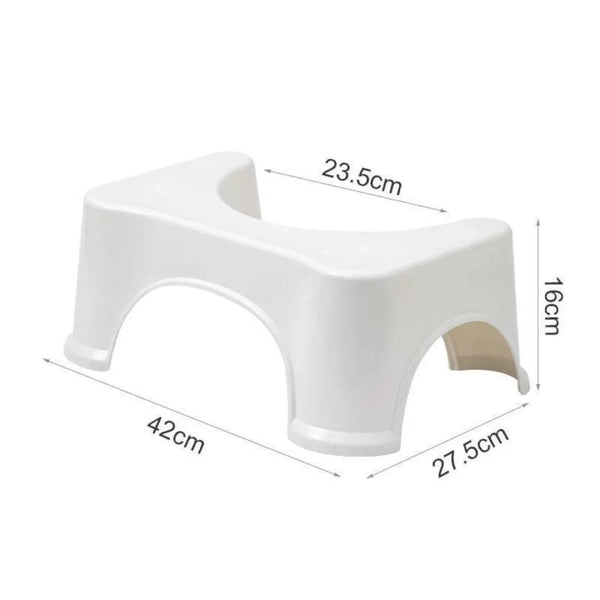
What does help in the moment: get your knees above your hips on a footstool, lean forward with a long spine, let your belly go completely soft, and breathe out through an open mouth rather than holding your breath and bearing down. Give it a few goes, and if nothing is happening, get up and come back when the urge returns. Timing helps too, because the bowel is most active in the half hour after a meal, and for most people the strongest signal of the day arrives after breakfast. The full method is in our toilet technique guide.
The honest version, though, is that the real work happens hours to days earlier. You cannot fix hard stool at the moment you're sitting on it.
Fibre: how much, and how to add it without regretting it
Fibre is the main lever. The NHMRC sets the Adequate Intake for dietary fibre at 25g a day for adult women and 30g for adult men, and Continence Health Australia suggests aiming for at least 30g a day for bowel health specifically. Most Australians fall well short of both.
Two practical rules make the difference between fibre helping and fibre backfiring. Increase it gradually over a couple of weeks rather than overnight, or you'll get bloating and wind and give up. And increase your fluid at the same time, because fibre works by holding water. Fibre without fluid can make hard stool harder.
Where it comes from matters less than that it's varied: wholegrain bread and cereals, oats, legumes and beans, nuts and seeds, and fruit and vegetables with the skin left on where you can.
Do prunes and kiwifruit actually work?
They do, and there's a decent trial behind that rather than just folklore. Chey and colleagues, publishing in the American Journal of Gastroenterology in 2021, compared three ordinary options in adults with chronic constipation: two green kiwifruit, 100g of prunes, or 12g of psyllium husk daily, each delivering around 6g of fibre. Over four weeks, all three improved how often people went and reduced straining, with prunes performing slightly best on most measures.
The useful takeaway isn't that one food is magic. It's that a modest, specific, daily amount of the right kind of fibre changes things within weeks, and you get to pick the version you'll actually keep doing.
How much fluid do I need?
Continence Health Australia suggests 1.5 to 2 litres, roughly six to eight glasses, of fluid a day unless your doctor has told you otherwise. That includes water, tea, coffee, milk and soup, not just plain water.
If you have a heart or kidney condition, or you've been given a fluid restriction, follow that advice over any general figure, including this one.
Movement counts more than people expect
Physical activity keeps the bowel moving, and it's one of the changes people notice fastest. It doesn't have to be a workout. A daily walk is genuinely useful, and if constipation has arrived alongside a period of being less active, illness, injury, a new baby or a desk-bound stretch, that's often a large part of the answer.
What about laxatives?
They have a place, and they aren't a first resort. Continence Health Australia describes three broad types (bulking agents, lubricant laxatives, and stimulant or irritant laxatives) and notes that generally they should only be taken for short periods. Healthdirect makes a related point: used incorrectly, laxatives can make it harder to get back to a normal bowel pattern once you stop.
Which type suits your situation depends on what's causing the problem, what else you take, and whether you're pregnant or breastfeeding. That's a conversation with your pharmacist or GP, not something to work out from a blog. We don't stock laxatives and we're not going to recommend one.
Constipation in pregnancy and after birth
This deserves its own mention because it's so common and so rarely warned about. In pregnancy, hormonal changes slow gut transit and iron supplements compound it. After birth, you've often got all of that plus dehydration from breastfeeding, disrupted routines, less movement, and pain relief that slows things further.
Then there's the part nobody says out loud: after a tear, an episiotomy or stitches, a lot of women are frightened of that first bowel motion and put it off, which makes the stool harder and the whole thing worse. If that's where you are, the answer is to keep the stool soft rather than to be brave. Ask your midwife, pharmacist or GP about a stool softener early rather than waiting until you're stuck, use the position and breathing above, and support your perineum with your hand or a folded pad of toilet paper while you go. That support is a legitimate technique, not a sign anything has gone wrong.
Why a pelvic physio cares about your bowels
Because straining is a load problem, and the load lands on your pelvic floor. Every hard, breath-held push sends pressure down onto the tissues that support your bladder, uterus and bowel. Occasionally, your body absorbs it. Daily for years, and chronic straining sits on the recognised list of contributors to pelvic organ prolapse, alongside pregnancy, birth, chronic coughing and heavy lifting. It's also a well-known aggravator of haemorrhoids.
If you already have a prolapse, or a rectocele where stool gets caught in a pocket of the vaginal wall, sorting out stool consistency isn't a side issue. It belongs in your management plan next to your exercises.
Constipation danger signs: when to see a doctor
Most constipation is a diet, fluid, movement and habit problem. Some of it isn't, and these are worth a GP appointment rather than another remedy:
- Blood in your stool, or on the toilet paper
- An unexplained, persistent change in your usual bowel habit
- Unexplained weight loss
- Severe abdominal pain, cramping or bloating, or vomiting
- Constipation that doesn't shift despite doing the sensible things
- Constipation that started with a new medication
- A family history of bowel cancer or inflammatory bowel disease
Worth knowing separately from any symptoms: Australia's National Bowel Cancer Screening Program now covers ages 45 to 74, with a free test kit posted every two years. If you're 45 to 49 and haven't had your first one, you can request a kit rather than wait for it to arrive.
When a pelvic health physiotherapist is the right call
If you've fixed the fibre, the fluid and the position and emptying is still a struggle, the problem may not be the stool at all. Some people push down with the pelvic floor at the moment it should be relaxing and opening, which no amount of effort or fibre will overcome, and which you can't see or correct on your own. A pelvic health physiotherapist can assess how your pelvic floor behaves during a bowel motion, teach you the coordination, show you where to place your hand if splinting helps, and work out whether a prolapse is part of the picture. No referral is needed to book one in Australia.
For free, confidential advice from a continence nurse, the National Continence Helpline is 1800 33 00 66.