There's a right way and a wrong way to poo. It sounds like the last thing on earth you'd need instruction in, and yet it's one of the most useful things we teach in a pelvic health clinic. Most people were never shown how, and the default modern setup, sitting upright on a high seat with your feet dangling and your phone in hand, is close to the worst position for the job.
This isn't about constipation, though good technique certainly helps if you're prone to it. It's about the mechanics of emptying your bowels well every day, whatever your stool is like, because how hard you have to strain either protects your pelvic floor or slowly works against it. Straining puts repeated downward pressure through the same structures that support your bladder, uterus and bowel, and that pressure is a recognised contributor to both haemorrhoids and pelvic organ prolapse. Position won't do the work for you. What it does is mean you need far less force to get the job done, and force is the part that costs you. The mechanics are simple, free, and you can use them on your very next trip to the bathroom.
Why the way you sit on the toilet matters
There's a muscle called puborectalis that slings around the rectum and holds it in a kink. That kink is doing you a favour most of the day, because it's part of what keeps you continent. To empty properly, that kink needs to straighten out, and the angle it sits at depends heavily on where your knees are.
Sitting bolt upright with your knees level with your hips keeps the kink partly in place, so you end up pushing stool around a bend. Raise your knees above your hips and lean forward and the angle opens up. Same effort, far less resistance. This is why the position below isn't a wellness trend; it's plumbing.
The correct way to poo, step by step
Here's the technique we teach in clinic. It's the same position Continence Health Australia recommends: knees above hips, leaning forward, letting the bowel open without strain.
- Get your knees above your hips. Put your feet on a footstool, a stack of books, an upturned box, whatever is to hand. The right height is simply whatever gets your knees clearly above your hips with your feet flat and supported, which depends on your leg length and your toilet rather than on any set measurement.
- Lean forward and rest your elbows on your knees. Keep your back long rather than slumped, and let your feet stay supported.
- Let your belly go completely soft. This is the step everyone skips. Holding your stomach in works directly against you. Let it relax and widen.
- Breathe out instead of holding your breath. Breathe in through your nose, then breathe out through an open mouth, making a low sound: a moo, a groan, a hiss, whatever feels least ridiculous. The sound isn't optional decoration, it's what keeps your throat open so pressure doesn't build and slam downwards.
- Widen, don't clench. As you breathe out, think of widening your waist and bulging your lower belly outward, while letting your back passage relax and open. Physios sometimes call this brace and bulge. It moves stool along without the breath-held bearing down that damages your pelvic floor.
- Go when you get the urge. Repeatedly ignoring the signal teaches your bowel to stop sending it clearly. The gut is also most active in the half hour or so after a meal, and for most people the strongest signal of the day comes after breakfast.
How long should you sit on the toilet?
Not long. A few minutes is plenty. Try the breathing a handful of times, and if nothing is happening, get up and come back when you next feel the urge. Sitting and pushing for twenty minutes achieves nothing except sustained downward pressure on tissue that doesn't need it, and long sits are one of the classic aggravators of haemorrhoids.
The practical version of this advice: leave your phone outside the bathroom. It's the single most common reason people sit far longer than they realise.
Do toilet stools actually work?
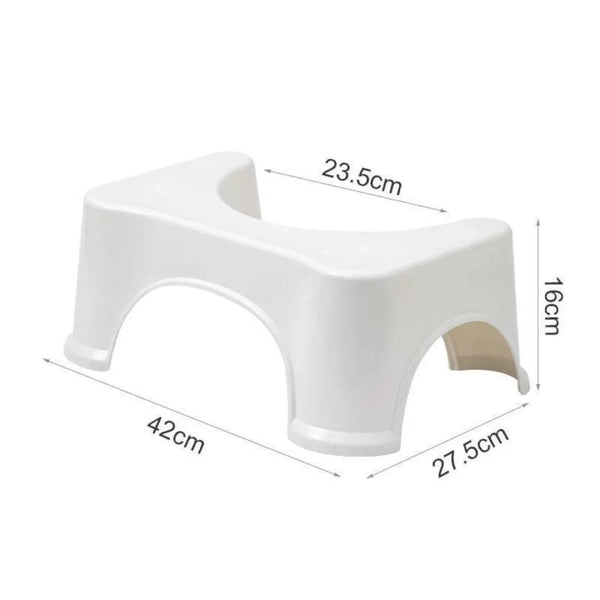
For a lot of people, yes, and the mechanism is exactly the one above: a stool lifts your knees and opens the anorectal angle. A 2025 review of toilet-posture research found that using a footstool cut the time taken to empty from around 113 seconds to 55, and lowered how hard people rated their straining.
It's worth being straight about the limits, though, because the trials are small and they don't all agree. One randomised trial found a footstool made no measurable difference for people with general constipation, while another found it did help a subgroup with specific difficulty emptying. So: a stool is a cheap, harmless thing to try, it helps some people a great deal, and it isn't a fix for everyone. If it doesn't change anything for you, that's useful information rather than a sign you're doing it wrong.
You do not need a branded one. A small footstool, a child's step or a firm box does the same job, and the best height is whatever gets your knees clearly above your hips with your feet flat and supported.
Where a purpose-made toilet stool wins is that it's the right height without thinking, and it tucks around the base of the toilet so it isn't in the way. Where it doesn't help is if you use it and keep straining anyway. The position sets you up; the breathing does the work.
How do I fully empty my bowels?
For most people, full emptying comes from the combination above: knees above hips, belly soft, breathing out through an open mouth instead of bearing down, and going when the urge arrives rather than an hour later. If you're doing all of that and still feel like something is left behind, there are two specific culprits worth knowing about.
The first is a rectocele, where the rectum bulges into the back wall of the vagina and stool can genuinely get caught in that pocket. Supporting the perineum, the area between the vagina and the anus, with your fingers or a folded pad of toilet paper while you breathe out can help you empty properly. Some women support the back wall of the vagina instead. This is called splinting, plenty of people work it out by instinct, and it is a legitimate, teachable technique rather than something to be embarrassed about. A pelvic health physiotherapist can show you exactly where to place your hand for your anatomy.
The other common reason is coordination. Some people push down with the pelvic floor when it should be relaxing and opening, which no amount of effort will overcome and which you cannot see or correct from a blog post. That's an assessment job.
Should you push hard if it won't come out?
No. Every hard, breath-held push sends pressure down onto the pelvic floor and the tissues that support your bladder, uterus and bowel. Do it occasionally and your body absorbs it. Do it daily for years and it becomes one of the recognised contributors to pelvic organ prolapse, alongside pregnancy, birth, chronic coughing and heavy lifting. It's also a well-known aggravator of haemorrhoids.
This is the part we most want people to hear, because it's the one thing on the prolapse risk list you can change today, for free, without a single appointment. If you already have a prolapse, how you empty your bowels belongs in your management plan just as much as your exercises do.
What if you're actually constipated?
Technique helps, but it can only do so much with stool that's genuinely hard. Constipation is a separate condition with its own management, and good technique needs soft, formed stool to work with. The fundamentals are enough fluid across the day, a range of fibre from wholegrains, fruit, vegetables and legumes, and regular movement, because physical activity keeps the bowel moving too. Increase fibre gradually rather than overnight, and pair it with fluid, or it can backfire. Long-standing constipation is also one of the quieter drivers of pelvic pain, which is one more reason not to just live with it.
If you're pregnant, taking iron, or on medications that constipate, that's a conversation with your GP or pharmacist rather than something to push through. Literally.
When to see a doctor
Most difficulty emptying is a habit-and-mechanics problem. Some of it isn't, and these are worth a prompt GP appointment rather than another week of trying:
- Blood in your stool or on the toilet paper
- An unexplained, persistent change in your usual bowel habit
- Unexplained weight loss
- Ongoing abdominal pain, or vomiting
- Constipation that doesn't shift despite doing the sensible things
- A family history of bowel cancer or inflammatory bowel disease
When to see a pelvic health physiotherapist
If you've corrected your position and your breathing and emptying is still a struggle, an assessment is the shortcut. A pelvic health physio can assess how your pelvic floor behaves during a bowel motion, teach splinting if you need it, and sort out whether a prolapse is part of the picture.
If prolapse is part of yours, you can browse the prolapse support products our physiotherapist-led team stocks to sit alongside a physio's plan. And for free, confidential phone advice from a continence nurse, the National Continence Helpline is 1800 33 00 66.
References
- Continence Health Australia. Supporting bowel control. continence.org.au
- Continence Health Australia. Pelvic organ prolapse. continence.org.au
- Healthdirect Australia. Rectocele. healthdirect.gov.au
- Rahgoshay N, Rahdar M, Nikoo L, Daneshmandi H. Sitting vs. squatting: a scoping review of toilet postures and associated health outcomes. BMC Public Health. 2025;25:2192. doi.org/10.1186/s12889-025-23379-8
- Trieu H, et al. Using a footstool does not aid simulated defecation in undifferentiated constipation: a randomized trial. Neurogastroenterology & Motility. 2023. doi.org/10.1111/nmo.14580
- Ulsh L, et al. Use of a footstool improves rectal balloon expulsion in some patients with defecatory disorders. Neurogastroenterology & Motility. 2024. doi.org/10.1111/nmo.14781
- Kuo CH, Martingano DJ, Mikes BA. Pelvic Organ Prolapse. StatPearls. Updated 2025. ncbi.nlm.nih.gov
This article is general information from a pelvic health physiotherapy perspective and isn't a substitute for individual assessment. If emptying your bowels is a daily struggle, your GP or a pelvic health physiotherapist can help you work out why.