Vaginismus treatment: how to relax your pelvic floor and reduce pain with penetration
If penetration feels painful, impossible or like your body is bracing before you've even tried, the first thing I want you to know is this. You're not broken. You're not "too tight." Vaginismus is treatable.
I'm Jade, a pelvic health physiotherapist, and vaginismus is a condition I see frequently in clinic. With the right relaxation work, gradual exposure and nervous-system support, most women improve significantly. Many resolve it entirely.
This guide walks through what vaginismus is, why it happens, what evidence-based treatment looks like, and what you can safely start doing at home today.
What is vaginismus?
Vaginismus is an involuntary tightening of the pelvic floor muscles when something tries to enter the vagina. The muscles brace before you can stop them.
It can happen with:
- Tampon insertion
- Menstrual cups
- Sexual intercourse
- Vaginal dilators
- Pelvic examinations and pap smears
You're not choosing the tightening. It's a protective reflex. Your nervous system anticipates discomfort, and your pelvic floor responds by contracting. Over time, that response can become so automatic you don't even notice it happening. You only notice the pain that follows.
Primary and secondary vaginismus
- Primary vaginismus - penetration has been painful or impossible from the very first attempt. Often picked up at the first tampon or the first attempt at sex.
- Secondary vaginismus - penetration was comfortable in the past, then became painful or impossible. This often follows childbirth, pelvic surgery, hormonal changes, recurrent infections, vulvodynia, endometriosis or a distressing sexual experience.
Both are treatable. The pathway is broadly the same, but the starting point and emotional load can look quite different.
What does vaginismus feel like? Common symptoms
These are the descriptions I hear most often in clinic:
- A burning or stinging at the vaginal entrance
- The sensation of "hitting a wall" when anything tries to go in
- Sharp pain on tampon insertion, or being unable to insert one at all
- Pain during pelvic exams or pap smears
- Painful intercourse, or intercourse that simply isn't possible
- A clenching that happens before you've even tried, almost anticipatory
Painful intercourse is more common than people realise. Most pelvic floor physiotherapists see vaginismus weekly. That's not to normalise it. It's to say the treatment path is well-trodden, because so many of us have needed it.
What causes vaginismus?
Rarely one single thing. Usually a combination of factors that have layered on each other over time.
- Pelvic floor overactivity - the muscles sit in a chronically guarded, contracted state. Penetration meets resistance, which makes the next attempt worse. This is about muscle tension, not anatomy or vaginal size.
- Nervous-system sensitisation - if your brain has learned that penetration equals pain, it acts to protect you. The pelvic floor tightens before penetration even happens. Even when the original trigger has resolved (an infection cleared, a tear healed, a difficult relationship ended), the protective reflex can remain.
- Hormonal and tissue changes - low oestrogen during breastfeeding, postpartum recovery or perimenopause makes vaginal tissue thinner and more sensitive. Recurrent thrush, BV or skin conditions like lichen sclerosus can also drive the cycle.
- Emotional and relational factors - anxiety, fear of pain, a history of trauma or a partnered context that doesn't feel safe can all hold the pelvic floor in tension. None of this means vaginismus is "in your head." It means your body is doing what a body is built to do: protect itself.
Can vaginismus be cured?
Yes, in most cases. The published outcomes for guided physiotherapy paired with graduated dilator work are strong. The catch is that recovery takes patience, not effort. The harder you push, the more your nervous system braces. The slower you go, the faster the muscles let go.
How long does it take to treat vaginismus?
There's no neat answer. Some women see meaningful change within a few weeks of daily breathing and stretching. Others work over six to 12 months alongside a pelvic floor physio, particularly where there's a history of trauma, endometriosis or longstanding pain. The first sign of progress is usually a softer, less reactive pelvic floor, not pain-free penetration on day one.
How to treat vaginismus at home: start with relaxation
Before strengthening, before dilators, before anything else, the pelvic floor has to learn how to let go. If it can't drop, nothing else will work.
Diaphragmatic breathing
This is the foundation. The single most important exercise on the list.
- Lie on your back with your knees bent and feet flat
- Place one hand on your chest and one on your lower belly
- Inhale slowly through your nose and let the belly hand rise. Keep the chest hand still
- As you breathe in, picture your pelvic floor softening down toward the mat
- Exhale slowly through your mouth, and let it stay soft
Practise this for five to 10 minutes, daily.
At first you may not feel much. That's normal. The connection between the diaphragm and the pelvic floor is something the body learns through repetition, and the awareness builds over weeks, not minutes.
Vaginismus exercises and stretches at home
Once the breathing feels settled, pair it with positions that lengthen the pelvic floor and the muscles that share its workload: the inner thighs, the glutes and the hip rotators.
- Figure-four stretch - lie on your back, cross one ankle over the opposite knee, and gently draw your thigh towards your chest. Breathe down into the hip.
- Child's pose - knees wide, big toes together, hips back towards your heels, arms reaching forward. Breathe slowly into the lower abdomen and pelvis.
- Happy baby - on your back, hold the outside of your feet, and let your knees open wider than your torso. The point is to let gravity open you, not to force it.
- Supported deep squat - feet slightly wider than the hips, dropping into a squat with blocks, a cushion or a chair behind you. Breathe steadily. Don't force the depth.
- Adductor stretch - sit with the soles of the feet together, knees falling outwards. Or kneel and slide one leg out to the side. Breathe into the inner thigh.
None of these should feel like a strain. The goal is opening, not stretching to your edge.
Should you do Kegels for vaginismus?
Usually no, and this matters. The standard Kegel — a pelvic floor squeeze — adds tension to muscles that are already over-contracted. For most people with vaginismus, Kegels make symptoms worse, not better. The work is in the opposite direction: lengthening, releasing, breathing down. If you've been told to "do your Kegels" by a GP who didn't assess your pelvic floor, this is the piece that often gets missed.
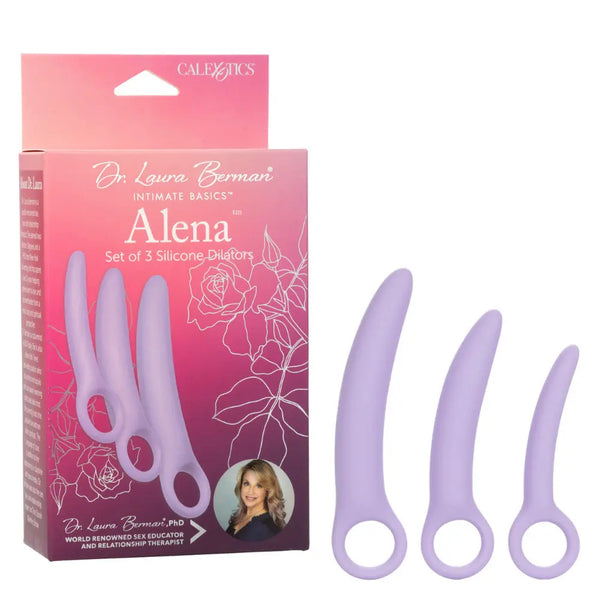
Vaginal dilators for vaginismus
Graduated dilator work is one of the best-evidenced parts of home treatment. The idea isn't to stretch the vagina open. It's to retrain the pelvic floor and the nervous system to understand that something inside the vagina can be safe.
Used well, dilators help:
- Reduce the protective muscle reflex
- Improve pelvic floor relaxation control
- Increase tissue tolerance
- Rebuild confidence around what your body is capable of
Start with the smallest size you can comfortably hold against the vaginal opening. Use plenty of lubricant. Pair every session with the breathing you've been practising. Progress is measured in weeks, not minutes.
The non-negotiable rule: never push through pain. Pain reinforces the protective reflex you're trying to unwind. If a size feels sharp, you go back a size, breathe, and try again another day.
Structured dilator sets with multiple gradual sizes tend to make progression smoother than single-size devices. The Amielle Comfort plastic set uses a tapered tip across five incremental sizes, which makes the jumps between sizes feel small. The Intimate Rose silicone set is the body-safe-silicone equivalent, often the choice where tissue is sensitive or post-surgical. If you'd like a more detailed walk-through, our guide to vaginal dilators covers sizing, materials and a starter protocol. You can also browse the vaginal dilator range Blossom stocks.
What comes after dilators isn't always intercourse
The default story is: dilators → intercourse. That's the path some women want, and it's a reasonable goal. But it isn't the only one, and framing recovery as "I'll be better when I can have penetrative sex" can set you up to feel like everything before that is failure.
Once your pelvic floor has learned to drop and tolerate insertion comfortably, the next step can be whatever you actually want. For some women that's:
- External vibration on the vulva, clitoris and perineum, with no insertion required
- Partner touch, oral sex or mutual masturbation, with or without any vaginal penetration at all
- Non-insertion intimacy that rebuilds your sense of being a sexual person without putting penetration in the middle of every encounter
- Solo insertion at your own pace, using your own fingers or a small vibrator, before any partnered intercourse is on the table
A lot of recovery happens once you stop measuring progress against "can I have intercourse yet" and start measuring it against "does my body feel safe and responsive."
What if dilators work but intercourse still doesn't?
This is one of the most common patterns I see, and I want to name it out loud because it can feel demoralising. Many women progress comfortably through a full dilator set and then find that intercourse still triggers the bracing reflex. Dilators haven't failed. Partnered sex carries layers a dilator session doesn't: another person's body, less control over depth and pace, vulnerability, and often years of pain memory tied specifically to intercourse.
A few things help bridge it:
- Have your partner present but uninvolved while you do dilator work, so your nervous system associates safety with the relationship
- Keep doing size-matched dilator sessions alongside early intercourse attempts, not instead of them
- Use a depth-limiting buffer like the Ohnut ring, which physically restricts how deep penetration goes so intercourse can be reintroduced without flares
- Slow the pace dramatically. The pace that worked solo isn't the pace that works partnered
When to bring in a pelvic wand
Once entrance-level desensitisation is comfortable and the next layer is releasing deeper trigger points inside the pelvic floor, a pelvic wand becomes the right tool. Our guide to using a pelvic wand at home covers how to find a trigger point safely, how much pressure to apply, and when not to use one. The pelvic wand range is here.
When to see a pelvic floor physiotherapist
If you're not making progress on your own, or the anxiety around penetration is high, working with a pelvic floor physio is one of the biggest accelerators available. A skilled physio shortens the recovery curve significantly.
A first appointment usually involves:
- A conversation about your history, your goals, and what you've already tried
- An external pelvic floor assessment
- An internal assessment only if and when you consent to one
- Hands-on or biofeedback-guided relaxation work
- A dilator programme matched to where you actually are, not where a generic protocol says you should be
- Education about pain science and nervous system regulation
In Australia, the APA Find a Physio directory lets you filter by pelvic health interest. Look for someone whose bio specifically mentions painful sex, vaginismus or persistent pelvic pain. Not every pelvic floor physio works in this space.
If you're not sure where to start, you're welcome to email hello@blossompelvichealth.com.au and I'll point you somewhere good.
A note from Jade
Vaginismus can feel isolating. I've spoken to women who have lived around it for years, adjusting their relationships and their sense of themselves rather than naming what's happening.
There is help. There's a treatment pathway with solid evidence behind it. And improvement is the most common outcome, not the rare one.
The hardest part is almost always the first step. The email, the booking, the first dilator session, the first time you say the word out loud to a clinician. After that, the path opens up.
If you have a question or just need a starting point, please reach out.